Wednesday, April 23, 2014

Unit 5- Sensation and Perception

Sensation: your window to the world
Perception: interpreting what comes in your window


SENSATION: the process by which our sensory receptors and nervous system receive stimulus from the environment.
Concepts....
1. Bottom-up Processing: begins with the sense receptors and works up to the brain's integration of sensory information.
2. Top-down Processing: information processing guided by higher level mental processes.


Absolute Threshold: the minimum stimulation needed to detect a stimulation needed to detect a stimulus 50% of the time.
Difference Threshold: the minimum difference that a person can detect between two stimuli.
Weber's Law: the idea that, to perceive a difference between two stimuli, they must differ by a constant percentage, not a constant.
Signal Detection Theory: predicts how we detect a stimulus amid other stimuli.
Sensory Adaptation: decreased responsiveness to stimuli due to constant stimulation
Selective Attention: the focusing of conscious awareness on a particular stimulus.
Cocktail Party Phenomenon: cocktail party effect describes the ability to focus on ones listening attention on a single talker among a mixture of conversations and background noises... Ignoring other conversations.

Energy Vs. Chemical Senses:
Vision: our most dominating sense.

  • The height of a wave gives us intensity (brightness)
  • The length of the wave gives us its hue (color)
  • ROY G BIV
  • The longer the wave, the more red it is. 
  • The shorter the wavelength, the more violet.
Transduction: transforming signals into neural impulses.... Transduction in the ear is when sound waves hit the eardrum then anvil then hammer then stirrup then oval window. 
Young-Helmholtz Theory:
Three types of cones...
  1. Red
  2. Blue 
  3. Green
-You can make millions of combinations of colors with these 3 primary colors.
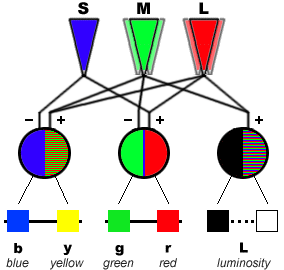
Opponent Process Theory: sensory receptors come in pairs.

  • Red and Green
  • Blue and Yellow
  • Black and White

If one color is stimulated, the other color in inhibited.


Sound
Important words when it comes to sound....
Amplitude and Wavelength
-The height of the wave gives us the amplitude.
-The longer the wavelength, the lower the pitch and vice versa.

Transduction in the ear


-Sound waves hit the eardrum, then the anvil, then the hammer, then the stirrup, then the oval window.
-The cochlea is lined with mucus called basilar membrane.
-In the basilar membrane, there are hair cells. 
-When hair vibrates, the vibrations turn into neural impulses which are called Organ of Corti.
-Sent to thalamus up auditory nerve.


Pitch Theories


  1. Place Theory: different hairs vibrate in the cochlea when there are different pitches, so some hairs vibrate when they hear high pitches.
  2. Frequency Theory: all the hairs vibrate at different speed.


Deafness

  1. Conduction Deafness: something goes wrong with the sound and the vibration is on its way to the cochlea.
  2. Nerve (sensorineural) Deafness: hair cells in cochlea get damaged.

Causes of deafness...


  • loud noise
  • no way to replace hairs
  • cochlea implant is possible
Why do we study smell and taste together??????

Sensory Interaction: the principle that one sense may influence another.

Taste

-We have bumps on our tongue called papillae.
-Taste buds are located on the papille (all over the mouth actually)
(picture of sweet salty bitter blah blah blah)

Touch

  • receptors located in our skin.
Gate control theory of pain: the spinal cord contains a neurological gate that contains blocked signals or allows them to pass onto the brain.
Vestibular Sense: tells us where our body is oriented in space
-Our sense of balance
Kinestetic Sense: tells us where our body parts are
-Receptors located in our muscles and joints
PERCEPTION: The process of organizing and interpreting information, enabling us to recognize meaningful objects and events.
Gestalt Philosophy: the whole is greater than the sums of its parts.
Figure Ground Relationship: the organization of the visual field into objects (figures) that stand out from their surroundings.
Grouping: the perceptual tendency to organize stimuli into groups that we undersand.
  • Proximity:
  • Similarity:
  • Continuity:
  • Connectedness: 
Depth Perception: the ability to see objects in 3 dimensions although the images that astrike the retina are two dimensional.
  • Allows us to judge distance
Visual Cliff: not being aware of how far down


Binocular Cues
Retinal Disparity: a binocular cue for seeing depth. The closer an object comes to you, the greater the disparity is between the two images.


Sunday, April 6, 2014

Death
Elizabeth Kubler-Ross' 5 Stages of Death...

  1. Denial
  2. Anger
  3. Bargaining
  4. Depression
  5. Acceptance


Social Development
  • Up until a year, infants do not mind strange people.
  • After about a year, infants develops stranger anxiety
Attachment
-Paul Lorenz discovered that some animals form attachment through imprinting.
-Harry Harlow and his monkeys
-Harry showed that monkeys needed touch to form attachment.
Critical Periods: the optimal period shortly after birth when an organism's exposure to certain stimuli or experiences produce proper development.
-Those who are deprived of touch have trouble forming attachment when they are olders.

3 Types of Attachment
Mary Ainsworth Strange Situation
3 Types of Attachment.....
  1.  Secure
  2. Avoidant
  3. Anxious Ambivalent
Parenting Styles
There are 3...
  1. Authoritarian Parents: parents are the bosses
  2. Premise Parents (laissez faire): children are the bosses
  3. Authoritative Parents (democratic): children participate. Parents and children compromise.
Erik Erikson
  • a neo-feudian
  • work with Anna Freud
  • believed that personality was influenced by our experiences with others.
Trust vs. Mistrust
"Is my world predictable or supportive?"
-The trust or mistrust they develop can carry on with one child for the rest of their life.

Autonomy vs. Shame and Doubt
-Toddlers begin to control their bodies (toilet training)
-Control temper tantrums
-Big word is "No"
-"Can they learn to control, or will they doubt themselves?" (Ages 2-3)

Initiative vs Guilt
-Words turn from "No!" to "Why?" (Ages 3-6)
-want to understand the world and ask questions.
-"Is their curiosity encouraged, or scolded?"

Industry vs. Inferiority 
"Am I successful, or worthless?"
-Ages 6-12
Do we feel bad about out accomplishments?
We are for the 1st time evaluated by a formal system and our peers.

Identity vs. Role Confusion
-In early teenage years, we try out different roles.
-Who am I?
-If i do not find myself, I may develop an identity crisis.

Intimacy vs. Isolation
-Have to balance work and relationship
-What are my priorities?

Generality vs. Stagnation
-Middle adult
"Will I succeed in life?"
-Is everything going as planned?
-Am I happy with what I've created?
-Mid life crisis!!!

Integrity vs. Despair
-Look back on life.
-Was my life meaningful, or do I have regret? (Elderly people)

Jean Piaget's Stages of Cognitive Development
  1. Sensorimotor stage: Babies are relying solely on their senses
  2. Pre Operational stage: 
  • Ages 2-7
  • babies begin to use language to represent objects and ideals
  • Egocentric: cannot look at the world through anyone else's eyes but their own.
  • Conservation: refers to the idea that a quantity remains the same despite changes in appearance and is part of logical thinking.
      3. Concrete Operational Stage
  • can demonstrate concept of conservation
  • learn to think logically
  • Ages 7 to 11.
      4. Formal Operational Stage
  • abstract reasoning
  • manipulate objects in our minds without seeing them
  • hypothesis testing
  • trial and error
  • metacognition
  • not every adult gets to this tage
Types of Intelligence

Crystallized Intelligence
  • accustomed knowledge
  • increase with age
Fluid intelligence
  • Ability to solve problems quickly and think abstractly
  • peaks in the 20's then decreases over time.
Moral Development (Lawrence Kolberg)
3 Stages...
  1. Pre-Conventional Morality: morality based on rewards and punishments
  2. Conventional Morality: based on how others see you.
  • If your peers, or society, thinks it's wrong, then so do you.
     3. Post Conventional Morality: Based on self-defined ethical principles
  • Your own personal set of ethics.

Developmental Psychology

Nature vs. Nurture
Nature: you were born that way
Nurture: the way you were raised

Physical Development:

  • focus on your physical changes over time.
Prenatal Development

  • conception begins with the drop of an egg and the release of about 200 million sperm.
  •  The sperm seeks out the egg and attempts to penetrate the egg surface.
  • Once the sperm penetrates the egg, we have a fertilized egg called the zygote.
The Zygote

  • 1st stage of prenatal development. Last about 2 weeks and consists of rapid cell division.
  • After two weeks, the zygote develops into an embryo.
The Embryo

  • Lasts about 6 weeks
  • The heart begins to beat, and organs begin to develop.
The Fetus

  • By 9 weeks, we have a fetus.
Teratogens: chemical agents that can harm the prenatal environment.


Reflexes: inborn automatic responses..... 2 types.

  1. Rooting Reflex: a baby's tendency when touched on the cheek, to open the mouth and search for the nipple.
  2. Grasping Reflex: trying to grasp everything in reach.
Maturation: physical growth regardless of environment.
Puberty: period of sexual maturation during which a person becomes capable of reproducing.
Primary Sexual Characteristics: body's structures that make reproduction possible.
Secondary Sexual Reproduction: non reproductive sexual characteristics.

Landmarks for Puberty

  • menarche for girls (1st period)
  • spermarche for boys (first ejaculation)
Physical Milestone
Menopause: stop having menstrual cycles


The Brain

The Brain
The brain is made up of neurons and glial cells. Glial cells support neural cells.
Lesions: cutting the brain and looking for a change. Brain tumors also lesion brain tissues.

Brain Structures
Broken into three parts...
  1. Medulla Oblongata: controls heart rate, breathing, and blood pressure. ex: involuntary functions
  2. Pons: connects the hind,mid, and forebrain together.
  3. Cerebellum: Located in the back of our head. Another name is "little brain". It coordinated muscle movements and balance.
Midbrain: coordinates simple movements with sensory information. It contains the reticular formation.
Thalamus: in the forebrain. It deals with sensory information and sends them to appropriate areas of the brain. It's like a switchboard. It deals with all the senses BUT smell.
Limbic System: emotional control center of the brain. Made up of the hippocampus, hypothalamus, and the amygdala.
Hypothalamus: pea sized in brain, but plays a not so pea sized role. It controls body temperature, hunger, thirst, and sexual arousal (libido).
Amygdala: vital for our basic emotions... especially fear.
Hippocampus: memory processing.

Cerebral Cortex: top layer of brain
-contain wrinkles called fissures
-the fissures increase surface area of our brain.
-Laid out, the fissure would look like a  large pizza.

Hemispheres

  • Divided into left and right hemisphere.
  • Contralateral control- left controls the right side of our body. The right brain controls the left side of our body.
  • Righties are better at logic while lefties are better at spatial and creative tasks.
Split Brain Patients

  • The corpus callosum connects both the left and right hemisphere of the cerebral cortex.
  • When removed, you have a split brain patient.


The Cerebral Cortex is made up of  4 lobes...
  1. Frontal Lobe
  • Abstract through emotion and thoughts.
  • contains motor cortex: sends signals through our body using muscle movements.
  • contains Broca's area: responsible for controlling muscles that produce speech.
  • Damaged Broca's area is called Broca's Aphasia: unable to make movements or talk.
     2. Parietal Lobe

  • contains sensory cortex: receives incoming touch sensations from the rest of the body.
  • Most of the parietal lobe is made up of association areas: any area not associated with receiving sensory information or coordinating muscle movements.
      3. Occipital Lobe
  • deals with vision
  • contains visual cortex: interprets messages from out eyes into images we can understand.
      4. Temporal Lobe
  • processed through the ears.
  • contains Wernike's area: interprets written and spoken speech.
  • Wernike's Aphasia: unable to understand language- syntax and grammar is jumbled.

Unit 4: Biological Psychology


Biological Systems

Nervous System: The network of nerve cells and fibers that transmits nerve impulses between parts of the body. It starts with an individual nerve cell called a "neuron"
Resting Potential: the electrical potential of a neuron relative to its surroundings when not stimulated or involved in passage of an impulse.
Action Potential: the change in electrical potential associated with the passage of an impulse along the membrane of a muscle cell or a nerve cell
Threshold: You've reached the threshold when enough neurotransmitters reach the dendrites.
All or None Principle: The idea that either the neuron fires or it doesn't.
There is no part way firing.

Neurotransmitters: chemical messengers released by terminal buttons through the synapse.
Acetylcholine (ACH): deals with motor movement and memory.
-lack of ACH has been linked to Alzheimers Disease.
Dopamine: deals with motor movement and alertness.
-lack of dopamine has been linked with Parkinson's Disease.
Serotonin: is involved in mood control
-lack of serotonin has been linked to clinical depression
Endorphins: pain control
-Many and most addictive drugs deal with endorphins.
Drugs can be agonists, or antagonists.
Agonists: they take neuron fire
Antagonists: The stop the neuron from firing

Neurons
Sensory (afferent) Neurons: They take info from the senses to the brain
Inter (relay) neuron: They take messages from the sensory neurons to other parts of the brain or to motor neurons
Motor (efferent) Neurons: They take info from the brain to the rest of the body.

Nervous Systems
Central Nervous System (CNS): the brain and spinal cord
Peripheral Nervous System (PNS): all nerves that are not encase in the bone, and everything except the brain and spinal cord. PNS is divided into two categories...
  1. Somatic Nervous System- this nervous system controls voluntary muscle movement and uses motor neurons to transmit signals.
  2. Autonomic Nervous System- this nervous system controls automatic functions of the body. This nervous system can be divided into 2 categories... the Sympathetic and Parasympathetic Nervous Systems.

  • Sympathetic Nervous System: "Flight or Fight" response. It automatically accelerated heart rate, breathing, dilates pupils, and slows down digestion.
  • Parasympathetic Nervous System: automatically slows down the body after a stressful event. Heart rate and breathing slows down, pupils constrict, and digestion speeds up.
Reflexes: normally sensory (afferent) neurons take info up through the spine to the brain.


Wednesday, March 5, 2014

Motivational Psychology

Motivation:
need and desire that energized and directs behavior
Instinct Theory:
we are motivated by our inborn automated behaviors
Drive Reduction Theory:
the idea that a physiological need cheated an around tension state that motivated and organism to satisfy the need
Incentives:
pulled by a positive or negative environmental stimulus that motivated behaviors
Maslows Hierarchy of Needs:
Abraham Maslow said we are motivated by needs, and all needs are not created equal. We are driven to satisfy lower levels of needs first

Hunger
Hunger is both physiological and psychological
(Washburns studies showed hunger was particularly related to the stomach)
Biological Basis of Hunger:
Hunger does NOT come from your stomach; it comes from your brain.

Brain- The Hypothalamus
Lateral Hypothalamus:
When stimulated, it makes you hungry
Ventromedial Hypothalamus:
When stimulated, you feel full.

Leptin:
a protein produced by bloated fat cells
Set Point:
a theory that states everyone's body has a genetically determined range of weight and temperature that their body will try to maintain to stay at optimal health.
Body Chemistry:

  • glucose
  • the hormone insulin converts glucose to fat
  • when glucose levels drop, hunger increases
Externals: 
people who eating is triggered more by the presence of food than internal factors

Eating Disorders
Bulimia Nervosa:
binging
Anorexia Nervosa:
starving yourself below 85% of your normal body weight; you see yourself as fat
Obesity: severely overweight to the point where it causes health issues

Achievement Motivation
Instinct Motivators: Reward we get internally, such as enjoyment or satisfaction
Extrinsic Motivators: Reward that we get for accomplishments from outside ourselves

Management Theory
Theory X:
Managers believe that employees will work only if rewarded with benefits or threatened with punishments
 Theory Y:
Managers believe that employees are internally motivated to do work and policies should encourage this internal motive

Emotion
James- Lange Theory of Emotions:
experience of emotion is awareness of physiological responses to emotion arousing stimuli

  • We feel emotion because of biological changes caused by stress
  • The body changes ad our mind recognize the feeling

Cannon-Bard Theory of Emotion:
emotion- arousing stimuli simultaneous trigger:

  • physiological responses
  • subjective experience of emotion


Schachter's Two Factor Theory of Emotion:
to experience emotion you must:

  • be physically aroused
  • cognitively labeled as aroused

Two- Factor Theory of Emotion:
Biology and Cognition interaction with each other to increase the experience

Lie Detectors: 
machine commonly used to detect lies

Experienced Emotion
Catharsis: 
releasing aggressive energy
Feel Good, Do Good Phenomenon:
people tendency to be helpful when already in a good mood
Adaptation Level Phenomenon:
tendency to form judgements relative to a "neutral" level
Relative Deprivations: perception that one is worse off relative to those with whom one compares oneself

Social Relations

Prejudice:
an unjustifiable attitude towards a group of people

  • Social inequalities is the principal reason behind prejudice
Ingroup:
"us"=- people with whom one shares a common identity
Outgroup:
"them"- those perceived as different than ones ingroup
Ingroup Bias:
tendency to favor ones group

Scapegoat Theory:
theory that prejudice provides an outlet for anger by providing someone to blame
Just-World Phenomenon:
the belief that those who suffer deserve their fate
Aggression:
any physical or verbal behavior intended to hurt or destroy
Frustration Aggression Principle:
the blocking of an attempt to achieve some goal
Conflict:
a perceived incompatibility of actions, goals, or ideas

Attraction

  1. Proximity: Geographic Nearness
  2. Mere Exposure Effect: refers to the fact that repeated exposure to the stimulus breeds liking
  3. Similarity: "Birds of the same feather do flock together"  -breeds content
  4. Reciprocal Liking: You are most like someone that likes you
  5. Liking through Associations: Classical conditioning can play a part in attraction


Love
Passionate Love:
an aroused state of INTENSE positive absorption of one another
Compassionate Love:
the deep affectionate attachment we feel for those with whom our lives are intertwined
What makes love work?

  • Equity
  • Self- Disclosure
Altruism: unselfish regard for the welfare of others
Bystander Effect:
Bystanders less wiling to help if there aren't other bystanders around
Social Exchange Theory:
the idea that our social behaviors is an exchange process which we maximise  benefits and minimize costs.
Peacemaking:
Give people superordinate goals that can only be achieved through cooperation.